As we celebrate Women in Engineering Day on 23 June 2026, I extend my heartfelt congratulations to Women Engineers across the world—those who have chosen engineering as a profession, and those who practice it every day in ways that often go unrecognized. I am referring to the women who build families, nurture communities, solve problems, and shape futures. In many ways, mothers are among society’s first engineers and architects, designing lives and enabling generations to thrive.
Long before Engineering became a defined discipline, women were already applying many of its fundamental principles. From the earliest civilizations to today’s highly connected and technology-driven world, women have approached challenges with a perspective that is holistic, thoughtful, and deeply human. They have an innate ability to balance multiple priorities, anticipate future needs, and create solutions that work not just for individuals, but for entire families and communities.
At its core, Engineering is about creating better outcomes for people. It is about identifying challenges, designing solutions, and building systems that stand the test of time. When viewed through this lens, women have always been Engineers of progress.
India’s history is rich with examples of extraordinary women whose contributions reflected the spirit of Engineering and Nation-Building. Ahilyabai Holkar demonstrated visionary leadership through the development of roads, water systems, temples, and public infrastructure that improved the lives of countless citizens. Shakuntala Bhagat, often known as the “Queen of Structural Engineering,” challenged conventions and pioneered innovative, cost-effective construction techniques that strengthened India’s Engineering capabilities. Sudha Murty broke barriers as one of the first Women Engineers and used her technical mindset and leadership to create lasting social impact through education, healthcare, and philanthropy. Their journeys remind us that Engineering is not confined to drawings, machines, or technology. It is equally about improving lives, creating opportunities, and building a better society. Tata group exemplifies this fundamentally in Nation Building.
Today, engineering itself is evolving at an unprecedented pace. Traditional disciplines such as civil, mechanical, electrical, and computer engineering continue to form the foundation of modern development. At the same time, new frontiers are emerging rapidly. Artificial Intelligence, Data Science, Automation, Robotics, advanced analytics, and digital technologies are transforming the way we work, innovate, and solve complex challenges.
What is particularly encouraging is the increasing presence of women in these emerging domains. Across industries, women are moving beyond traditional career pathways and entering fields that were once considered unconventional or inaccessible. They are contributing as researchers, innovators, technologists, project leaders, entrepreneurs, and decision-makers. This shift is not merely about improving representation—it is about enriching innovation with diverse perspectives and experiences.
India, too, is witnessing unprecedented momentum, with women accounting for a significant proportion of STEM graduates and steadily increasing their participation in technology and engineering-led sectors. As industries navigate increasingly complex challenges, the ability to bring different viewpoints to the table will become a defining competitive advantage.
In my experience, one of the greatest strengths women bring to engineering is their ability to look beyond the obvious. A woman’s eye for detail, combined with a natural curiosity to uncover what lies beneath the surface, often enables her to identify opportunities and solutions that others may overlook. In a world that demands both precision and creativity, this ability is invaluable.
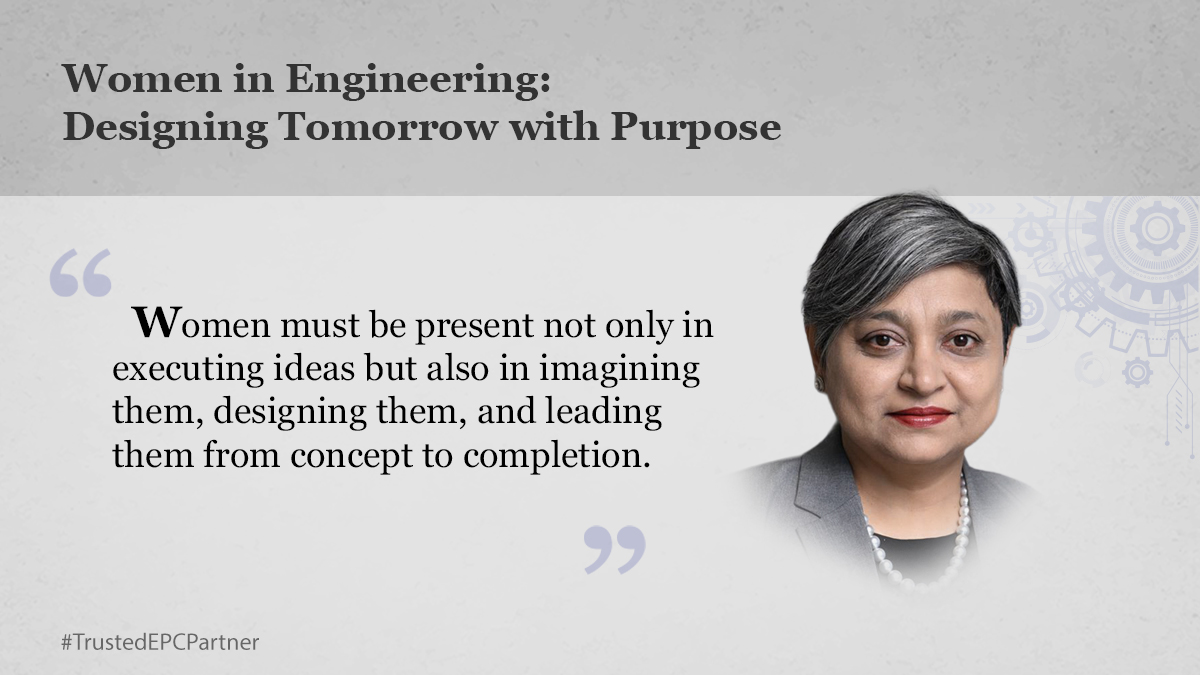
However, the future will not be shaped by opportunity alone. Women must continue to be active participants in creating the change they wish to see. Meaningful progress rarely comes from staying within comfort zones. It comes from stepping forward, embracing challenges, and taking ownership of outcomes. Women must be present not only in executing ideas but also in imagining them, designing them, and leading them from concept to completion.
I firmly believe that when more women help shape the future from the very foundation of ideas, the result is a world that is more innovative, more inclusive, and more sustainable. The world viewed through a woman’s lens is often one that considers everyone. And that is precisely the kind of future we should strive to Engineer together – Inclusive, Efficient & Sustainable!
Ms. Preiti Patel,
Chief Business Transformation Officer
Tata Projects Limited
Simplify. Create.